06 — RESEARCH & IMPACT
Following how youth voice travels into teacher education and action
The international action research asks how, for whom and under what conditions collective creative pedagogies make a difference.
 01
01Research questions
- How do young people define the changes education and future teachers need?
- How can Youth Catalysts be embedded meaningfully within ITE curricula?
- How do collective creative pedagogies activate social-emotional dispositions?
- How do pre-service teachers experience and interpret these approaches?
- What develops in creative identity, belonging, agency and ethical action?
- What enables or constrains transfer into placements, classrooms and programmes?
- What converges internationally, and what remains contextually distinctive?
Methods
Co-participatory and arts-based research, co-design, creative inquiry, action research, questionnaires, reflective responses, focus groups, creative artefacts, case studies and comparative international policy analysis.
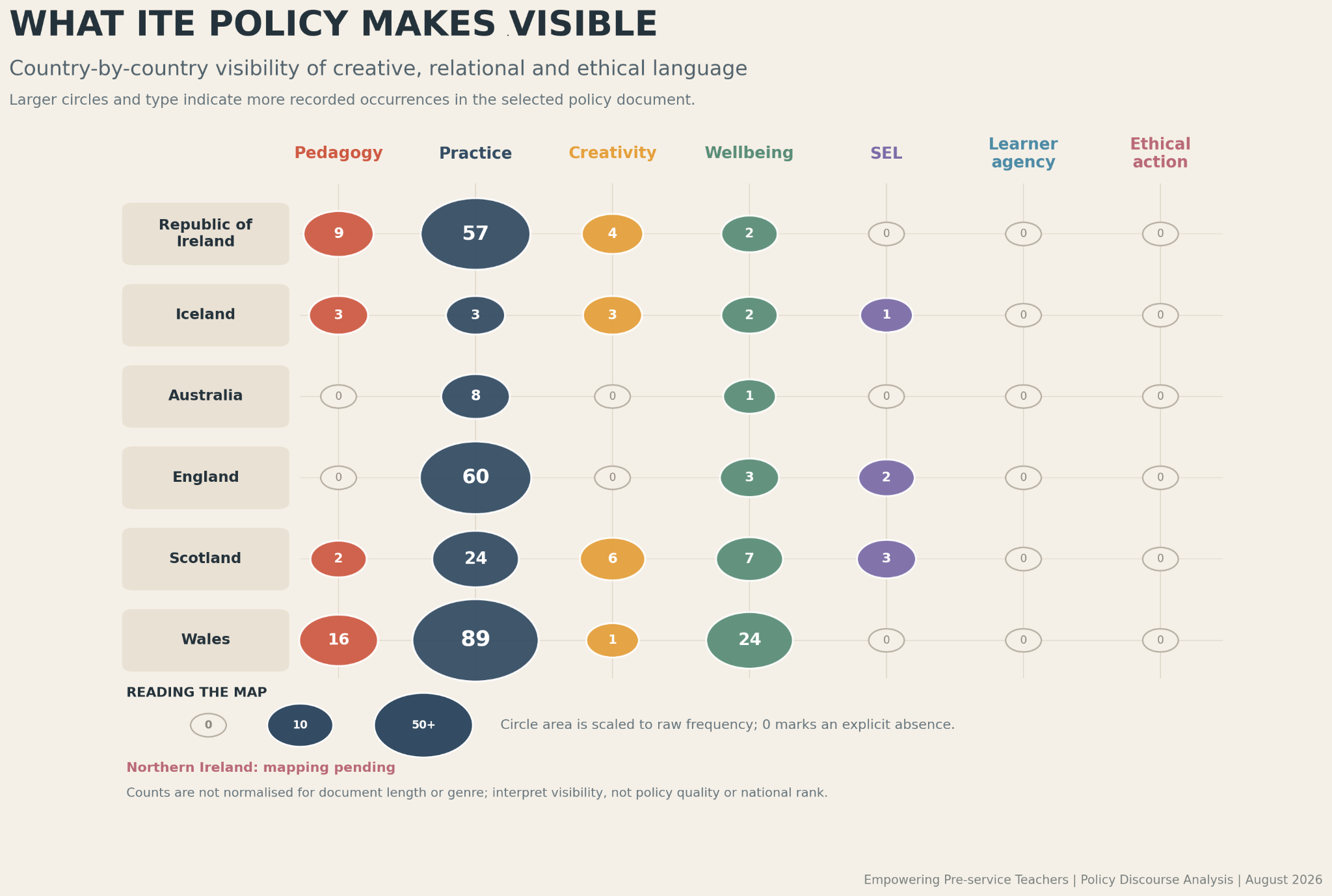
What ITE policy makes visible
This comparative map shows the recorded visibility of creative, relational and ethical language in selected ITE policy documents. Circle area represents raw frequency; the counts are not normalised for document length or genre and should be read as visibility, not policy quality or national rank. Northern Ireland mapping is pending.
Research gaps
- How embodied, relational creative pedagogies activate social-emotional dispositions.
- How youth-generated priorities can shape sustained ITE curriculum change.
- How creative identity and professional agency are addressed within policy and standards.
- The conditions needed to move from valuing creativity to embedding it.
- Comparative evidence across different national policy contexts.
Impact framework
- Youth — influence, representation and participation.
- ITE students — identity, confidence, belonging, understanding, repertoire and agency.
- Curriculum — modules, resources, assessment and programme structures.
- Practice — application in placements, classrooms and future teaching.
- Partnerships — sustained university, youth, artist, school and cultural collaboration.
- Policy — evidence and recommendations for teacher education and professional learning.
Explore research and impact by country
07Policy connections
- Arts Council of Wales — Year 1 co-funder and partner connecting creative learning, professional development and national change.
- Department for Education and Skills, Welsh Government — Year 1 co-funder and policy partner.
- Welsh Government policy colleagues — connecting emerging evidence with initial teacher education, curriculum and professional learning.
- OECD — international dialogue on creativity, agency, wellbeing and future-facing education.
- Chartered College of Teaching — professional connection and knowledge exchange with the teaching profession.
Using emerging evidence responsibly
The project distinguishes direct youth evidence, participant reflection, self-reported development, observed pedagogical change, curriculum embedding and longer-term learner impact. It asks not only whether change occurs, but how, for whom, under what conditions and within which policy constraints.
Reports, data and research media
Publications, data summaries, briefings and recorded research conversations will be added with clear evidence status and language labels.